
What Happened to Bill Maher?
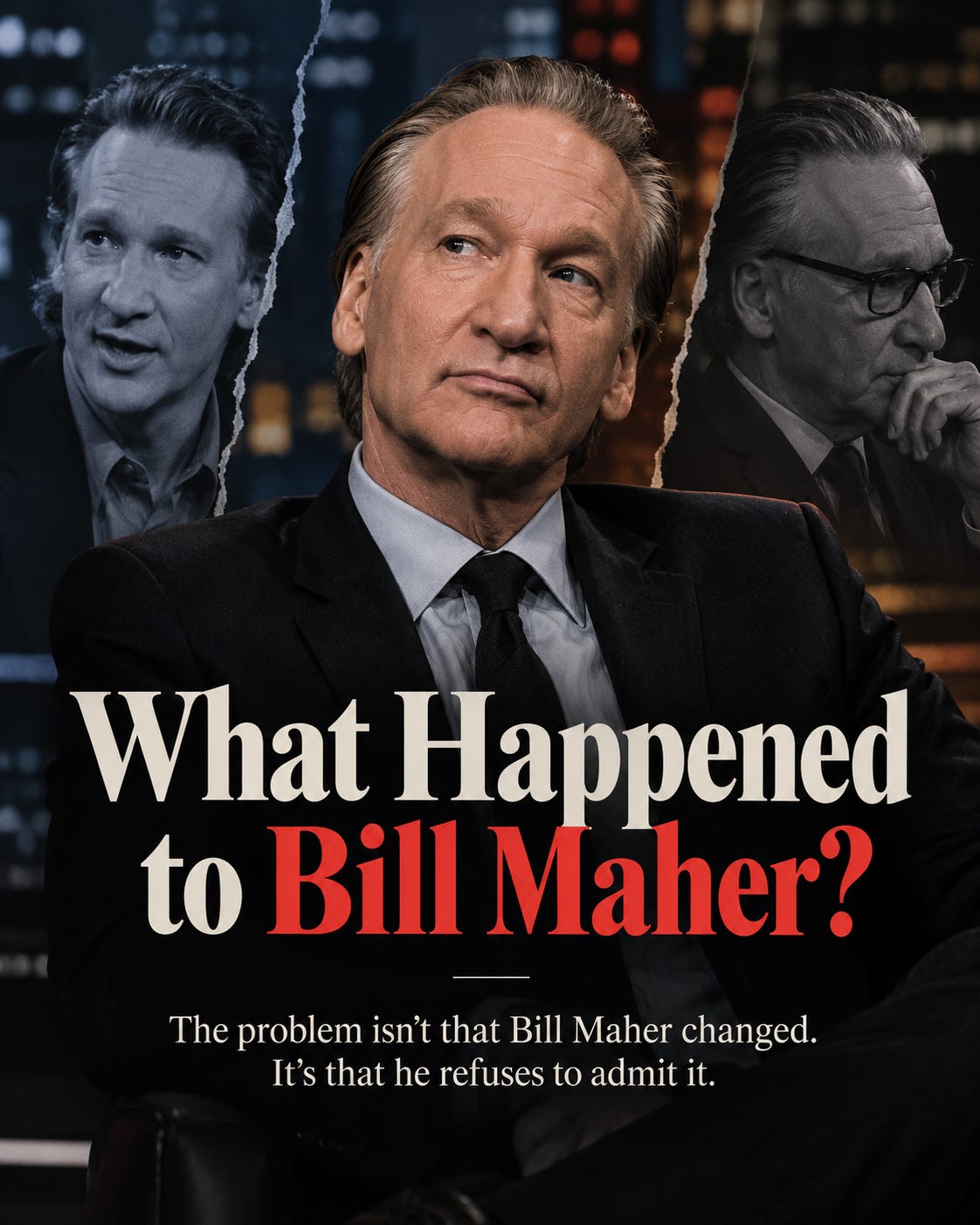
There was a time when watching Bill Maher felt dangerous.
Not dangerous in the manufactured, cable-news sense of the word. Maher was genuinely willing to say things other people wouldn’t say. He mocked religion. He attacked Republicans. He frustrated Democrats. He questioned political correctness before complaining about political correctness became its own multimillion-dollar industry. You didn’t have to agree with him to appreciate that there was something unpredictable about him.
That Bill Maher was interesting.
I’m not sure this Bill Maher is.
Somewhere along the way, Maher went from being the guy standing outside the political tribes throwing rocks at everyone to sounding increasingly like the cranky guy at the end of the bar explaining why college students, young people, progressives and “woke” culture have ruined America.
The rebellion became a routine.
And the strangest part is that Maher seems convinced he hasn’t changed at all.
His defense is essentially that he remains an old-school liberal while everyone around him moved. There is probably some truth in that. The Democratic Party has changed. American culture has changed. The Republican Party has changed dramatically too.
But pretending Maher has simply remained frozen in ideological amber while the entire country moved around him is difficult to believe.
Look at Donald Trump.
Maher spent years sounding alarms about Trump. He mocked him relentlessly, warned about his behavior and treated his political rise as something genuinely dangerous. Then came the now-famous 2025 White House dinner.
Afterward, Maher described a Trump the public rarely sees. He talked about Trump laughing at himself, being personable and engaging, and said that virtually everything he disliked about the public Trump was absent during their private encounter. Maher even said he felt more comfortable talking with Trump than he would have with Barack Obama or Hillary Clinton.
Having dinner with Trump wasn’t the problem.
Talk to everyone. Interview everyone. Sit across the table from people you despise. That is what journalists, comedians and intellectually curious people should do.
The problem was how easily Maher appeared impressed by access.
A private dinner does not erase public behavior. A president laughing at your jokes over dinner doesn’t tell Americans much about how he governs. Maher himself acknowledged that distinction, but the entire presentation still had the unmistakable feeling of someone discovering that the famous person he had spent years attacking was nice to him personally and suddenly finding that revelation enormously significant.
For someone who built a career mocking celebrity worship, it was an astonishingly starstruck moment.
Maher insists the dinner didn’t change his criticism of Trump, and there is evidence supporting him. He has continued criticizing Trump on subjects including ICE, DOGE and election denial. In June 2026, while interviewing Vice President JD Vance, Maher directly challenged the idea that Republican election losses could simply be dismissed as cheating.
But that almost makes Maher’s transformation more interesting.
Because this isn’t really about Bill Maher becoming a Republican.
It’s about Bill Maher becoming predictable.
You know where the rant is headed before it starts.
Young people are too sensitive.
College students are ridiculous.
Hollywood is too woke.
Progressives have gone too far.
Democrats don’t understand normal people.
Someone used the wrong pronoun.
Someone canceled someone.
Someone somewhere said something absurd on TikTok, and now apparently that person represents an entire generation or political movement.
The man who once seemed obsessed with exposing hypocrisy increasingly seems obsessed with proving that the kids are annoying.
That isn’t courageous counterculture.
That’s Thanksgiving dinner.
And lately Maher has gone even further. In July 2026, he said he could imagine voting for JD Vance if what he describes as the Democratic Party’s more radical or “communist” wing took control. Maher specifically pointed to ideas such as abolishing police and prisons as examples of politics he finds unacceptable.
Maher is entitled to those opinions.
But at some point, you have to stop pretending nothing has changed.
When one of America’s most recognizable liberal comedians is publicly contemplating voting for a Republican vice president while spending considerable airtime attacking the political left, describing the transformation as nothing more than principled consistency starts to feel incomplete.
Maybe Maher didn’t leave liberalism.
Maybe his version of liberalism simply calcified.
There is also an arrogance to modern Maher that feels different from his earlier irreverence. He doesn’t merely disagree with younger generations. He often seems genuinely irritated that they don’t recognize the obvious brilliance of Bill Maher’s worldview.
His politics increasingly seem organized around a simple principle:
Bill Maher is reasonable, and everyone standing farther away from Bill Maher is insane.
That makes for entertaining television.
It doesn’t necessarily make for insightful television.
The irony is that Maher spent decades ridiculing people who became trapped inside ideological bubbles. Now he sometimes appears trapped inside a generational one.
The culture changed. Language changed. Social norms changed. Politics changed. Some of those changes deserve criticism. Some deserve ridicule. Some progressive ideas absolutely deserve to be challenged.
But cultural criticism becomes lazy when the conclusion is predetermined.
There was once genuine suspense when Bill Maher began a monologue because almost anyone could become the target.
Today, you can practically hear the gears turning.
Young activists. Wokeness. Cancel culture. Democrats. Gen Z. Repeat.
Even his contrarianism has become conventional.
And perhaps that is the biggest disappointment.
Bill Maher once seemed like someone determined never to become comfortable.
Now he sometimes seems like a man extremely comfortable in the role of America’s wealthy, irritated uncle, complaining that the country no longer makes sense because it no longer looks exactly like the country he remembers.
Maher would probably say that’s because America changed.
Maybe.
But so did Bill Maher.
And the comedian who once made a career out of noticing when everyone else was full of shit might want to consider the possibility that, somewhere along the way, he stopped applying the same test to himself.