
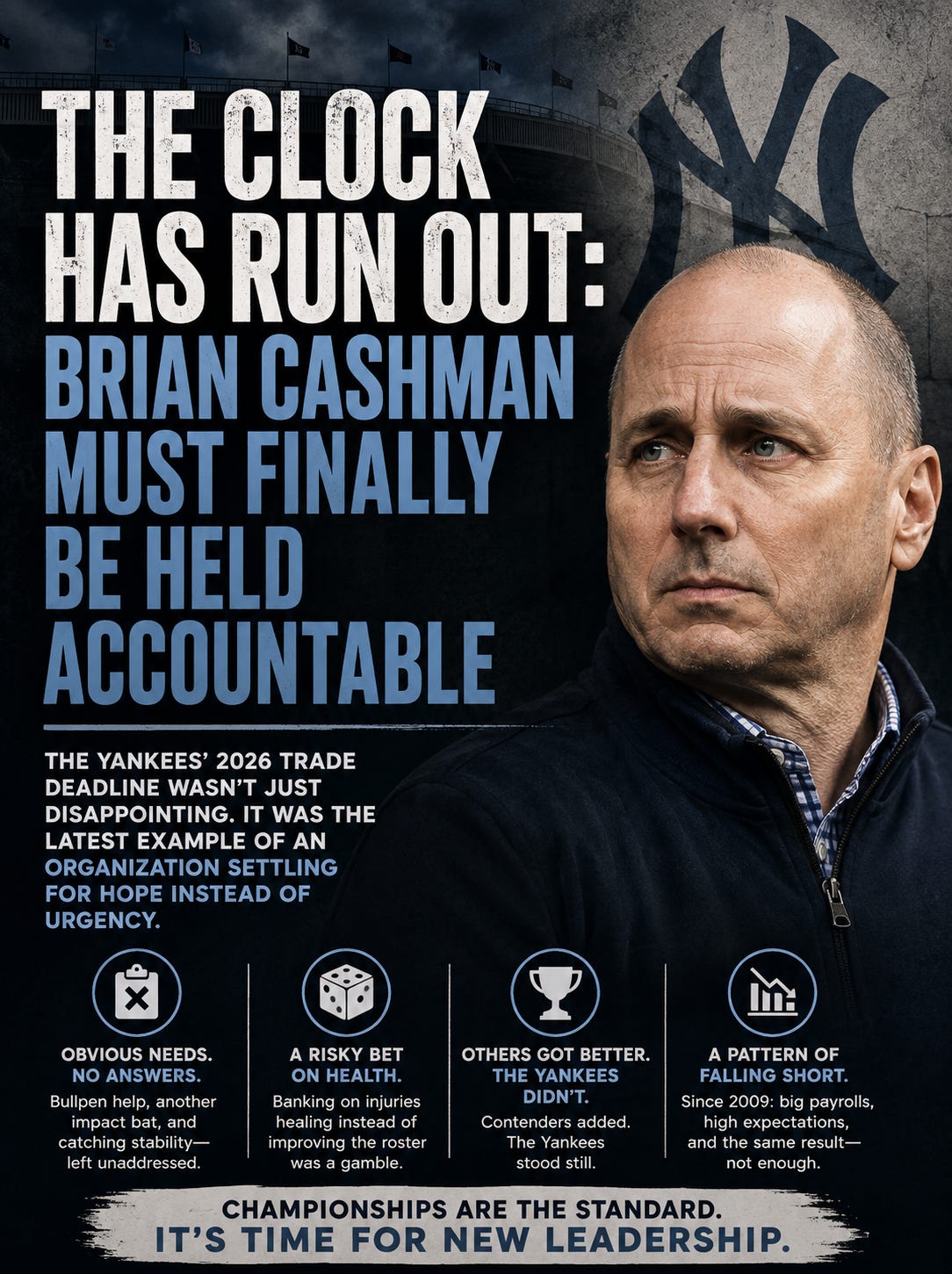
The Clock Has Run Out: Why Brian Cashman Must Finally Be Held Accountable
For nearly three decades, Brian Cashman has been one of the most influential executives in Major League Baseball. His resume includes World Series championships, playoff appearances, and countless blockbuster moves. That history deserves respect.
But history cannot become immunity.
At some point, every organization has to stop celebrating what was accomplished years ago and start evaluating what is happening today. After watching the Yankees stumble through another trade deadline with glaring needs left unanswered, I believe that moment has finally arrived.
This year’s trade deadline was inexcusable.
The Yankees entered the deadline with obvious flaws. They needed bullpen help. They needed another impact bat. They needed stability behind the plate. They needed to match the urgency displayed by other American League contenders. Instead, Brian Cashman made what amounts to one enormous gamble: that the roster already in place, combined with the return of injured stars, would be enough.
Hope is not a strategy.
Yes, Aaron Judge returning changes the lineup. Cody Bellinger getting healthy helps. Giancarlo Stanton can still change a game with one swing. But building a championship roster around “if everyone comes back healthy” is not how elite organizations operate. Great front offices prepare for uncertainty. They don’t bet their season on avoiding it.
Meanwhile, the rest of baseball acted.
The Dodgers once again behaved like a franchise determined to win another World Series. The Phillies aggressively improved. The Padres strengthened their roster. Even division rivals made meaningful additions while the Yankees watched opportunities pass them by.
I understand the argument that Cashman didn’t want to mortgage the future. Protecting top prospects has value. George Lombard Jr. could become a cornerstone player for the next decade. There is wisdom in refusing to make reckless trades simply to satisfy public pressure.
But this wasn’t about making a reckless move.
It was about recognizing the moment.
Championship windows are not permanent. Aaron Judge is one of the greatest players the Yankees have ever developed, but he won’t be in his prime forever. Gerrit Cole isn’t getting younger. Every season that ends without maximizing this core is a season that cannot be recovered.
The Yankees have spent years operating somewhere between rebuilding and contending. They collect prospects while simultaneously telling fans the goal is a championship. Eventually those two philosophies collide. You either push your chips into the middle of the table, or you accept that you’re building for tomorrow instead of today.
This deadline suggested the Yankees wanted both.
And that’s rarely how championships are won.
What makes this especially frustrating is that this isn’t an isolated mistake. It’s part of a pattern.
Too often, the Yankees have entered October with obvious weaknesses that everyone outside the organization recognized months earlier. Too often, they’ve relied on internal improvements, positional flexibility, or optimistic health projections instead of aggressively addressing deficiencies. Sometimes those bets work.
Far more often, they don’t.
Cashman deserves credit for helping build a consistently competitive organization. Most fan bases would gladly take the Yankees’ annual success over decades of losing baseball.
But “competitive” is not the Yankees’ standard.
The standard is championships.
Since the 2009 World Series, the Yankees have spent among baseball’s biggest payrolls while repeatedly falling short of the ultimate goal. At some point, ownership has to ask whether the message has grown stale and whether fresh leadership could better maximize the resources available.
This isn’t about assigning blame for every injury or every postseason loss.
It’s about accountability.
When the same executive oversees year after year of unmet expectations, eventually the responsibility rests with the person making the biggest baseball decisions.
I don’t question Brian Cashman’s intelligence. I don’t question his work ethic. I don’t question what he has meant to the Yankees organization.
I simply believe his time has run its course.
Sometimes organizations need a new voice, a new philosophy, and a new willingness to take calculated risks. The Yankees feel like a franchise that’s become comfortable defending decisions instead of demanding results.
That mindset has to change.
The 2026 trade deadline should be remembered as more than a missed opportunity. It should be remembered as the moment ownership finally recognized that standing still is falling behind.
For the New York Yankees, that realization is long overdue.