
Silencing Macklemore Won’t Silence Palestine
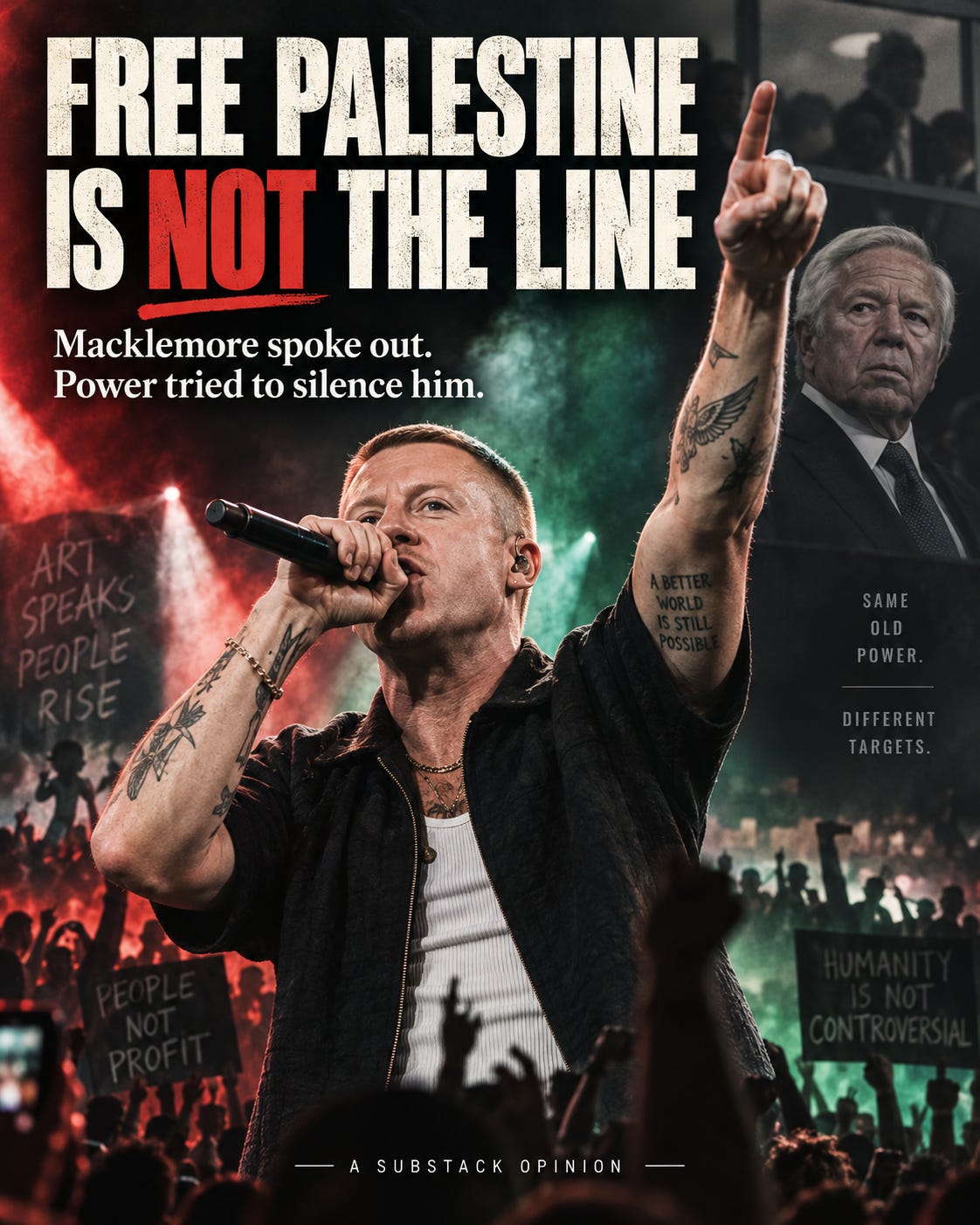
Robert Kraft wants us to believe this is about hate speech. I’m not buying it.
Macklemore was removed from the remaining U.S. dates of Ed Sheeran’s tour after using one of the biggest stages in America to say something that apparently made some very powerful people uncomfortable: Free Palestine.
According to Macklemore, Kraft, the billionaire owner of the New England Patriots and Gillette Stadium, told Ed Sheeran that Macklemore would not be permitted to perform at Gillette. Macklemore also says Kraft helped rally other stadium owners against him, creating a situation where Sheeran essentially had a choice: remove Macklemore or risk losing venues on his massive stadium tour. The tour promoter has confirmed that multiple venues objected to Macklemore remaining on the tour.
That is bigger than one concert.
That is what happens when people with enormous money and influence get to decide which political messages are acceptable enough to reach an audience.
And I think Macklemore is right to call it out.
During his performances at MetLife Stadium, Macklemore spoke in support of Palestinians, displayed images of the destruction in Gaza and performed “Hind’s Hall,” his protest song named after six year old Hind Rajab, who was killed in Gaza. He has been publicly advocating for Palestinians for years.
But suddenly, when that message reached an enormous stadium audience while Macklemore was opening for one of the biggest musicians in the world, it became unacceptable.
That should tell you something.
Kraft says Macklemore’s appearance at Gillette Stadium would have crossed a line because of what Kraft characterized as antisemitic rhetoric and imagery. He said advocating for Palestinians should not come at the expense of Jewish people and argued that Macklemore presents selective information while failing to adequately acknowledge Hamas.
But supporting Palestinian civilians is not antisemitism.
Condemning the actions of the Israeli government is not antisemitism.
Saying “Free Palestine” is not antisemitism.
And showing Americans images of what is actually happening to Palestinian civilians should not suddenly become forbidden because those images are painful or politically inconvenient.
We have become far too comfortable with this idea that criticism of the Israeli government must immediately be accompanied by a disclaimer, qualification or condemnation of somebody else before the criticism can be considered legitimate.
Macklemore does not owe Robert Kraft a carefully balanced foreign policy presentation before he is allowed to speak about dead Palestinian children.
He is an artist.
Artists have protested war, racism, government policy, inequality and injustice for generations. Some of the greatest music ever created came from artists refusing to stay quiet when staying quiet would have been easier and far more profitable.
That is exactly what makes protest art matter.
It costs something.
Macklemore knew speaking publicly about Palestine could cost him money, relationships, sponsorships and opportunities. Now it has cost him one of the biggest tours in the country. He has made it clear that he understands those consequences and intends to continue speaking anyway.
I respect that.
You do not have to agree with every word Macklemore says. You do not have to agree with every political position he has taken. You do not even have to like his music.
But there is something deeply troubling about billionaires effectively forming a coalition of venues capable of removing an artist from a national tour because they object to his political message.
Kraft owns Gillette Stadium. He absolutely has enormous control over what happens inside that building.
But having the power to silence someone does not automatically make exercising that power right.
And if Macklemore’s account is accurate, this went beyond Kraft making a decision about his own stadium. It became an effort to convince other powerful venue owners to apply enough pressure that Macklemore could no longer remain on the tour at all.
That should bother people regardless of where they stand on Israel and Palestine.
Because today the message being pushed off the stage is “Free Palestine.”
Tomorrow it could be something you believe in.
Free expression becomes meaningless if we only defend speech when it is comfortable, profitable and approved by the wealthiest person in the building.
There is another uncomfortable reality here.
If Macklemore had walked onto that stage, performed his biggest hits, collected his check and gone home, none of this would have happened.
Nobody would have threatened Ed Sheeran’s stadium dates.
Nobody would have demanded Macklemore’s removal.
Nobody would be issuing statements about lines being crossed.
The problem was not that Macklemore had a microphone.
The problem was that he used it.
He used it to force tens of thousands of people to confront something many Americans would probably rather avoid thinking about while attending a concert.
That is exactly what protest is supposed to do.
Protest that never makes anyone uncomfortable isn’t much of a protest.
Robert Kraft can call Macklemore’s message divisive. He can disagree with him. He can condemn him publicly. He can use his considerable platform to make the opposing argument.
What I cannot support is using billionaire influence to make the opposing voice disappear.
Macklemore had something to lose and spoke anyway.
Kraft had the power to shut the door.
He used it.
So if we’re going to talk about someone crossing a line, I don’t think Macklemore is the person we should be looking at.
Silencing him will not end the debate.
It certainly will not make the suffering in Gaza disappear.
And it will not silence the words that apparently caused all of this trouble in the first place.
Free Palestine.