
Shohei Ohtani Was Cleared. I’m Still Not Completely Convinced.
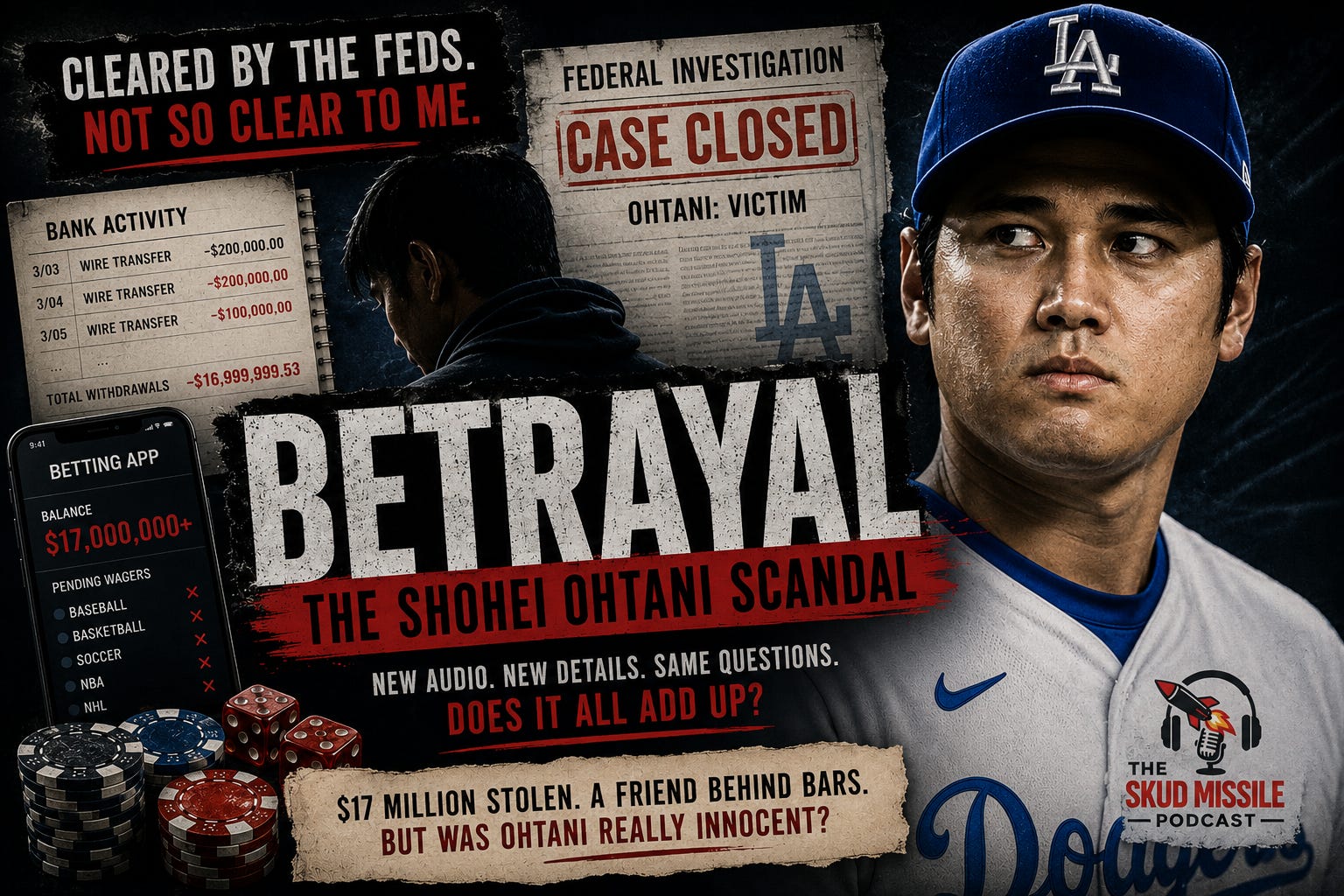
When the federal investigation into Shohei Ohtani’s gambling scandal concluded, Major League Baseball could finally exhale. The sport’s biggest star had officially been cleared of any wrongdoing, while his longtime interpreter, Ippei Mizuhara, admitted to stealing nearly $17 million from Ohtani’s bank accounts to fuel an illegal gambling addiction. Mizuhara pleaded guilty, accepted responsibility, and was sentenced to prison. From a legal standpoint, the case appeared to be over. Ohtani was the victim, not the perpetrator. Yet despite those findings, I have to admit that the story has never completely sat right with me, and ESPN’s new podcast examining the scandal hasn’t changed that feeling.
Before I go any further, I think it’s important to make something crystal clear. I am not accusing Shohei Ohtani of committing a crime, nor am I suggesting there is evidence that federal investigators ignored. The Department of Justice conducted an extensive investigation, reviewed financial records, phone records, text messages, and banking transactions, and ultimately concluded that Mizuhara acted alone. Those facts deserve to be acknowledged and respected. However, legal innocence and public confidence are not always the same thing. Sometimes a story can be officially resolved while still leaving people with legitimate questions that never seem to go away.
What has always been difficult for me to reconcile is the nature of the relationship between Ohtani and Mizuhara. For more than a decade, Mizuhara wasn’t simply translating interviews after games. He was Ohtani’s constant companion. He traveled with him, managed countless aspects of his daily life, handled logistics, assisted with communication, and by all accounts became one of the people Ohtani trusted most in America. The idea that someone could steal nearly $17 million over an extended period without Ohtani noticing anything unusual is certainly possible, but it’s also incredibly difficult for me to wrap my head around. That doesn’t mean it didn’t happen exactly that way. It simply means that, as someone following the story from the outside, it requires an extraordinary level of trust in an explanation that is itself extraordinary.
The new ESPN podcast introduces additional reporting and previously unheard audio, including recordings of Mizuhara allegedly impersonating Ohtani while attempting to authorize a $200,000 bank transfer. Many people have interpreted those recordings as further proof that Ohtani was the victim of an elaborate fraud. I understand why they feel that way. Ironically, I had almost the opposite reaction. Hearing how sophisticated and calculated the deception allegedly became only reinforced how remarkable the entire scheme was. It didn’t convince me that Ohtani was involved, but it also didn’t eliminate the questions that have lingered since this story first broke. If anything, it reminded me just how unbelievable the entire situation truly is.
Another reason this story continues to leave me unsettled is the enormous importance Shohei Ohtani holds within the sport. He isn’t simply another All-Star player. He is arguably the face of Major League Baseball and one of the most marketable athletes in the world. MLB has invested heavily in promoting Ohtani as the global ambassador of the game, and countless sponsors, television partners, and businesses have benefited from his popularity. To be clear, I am not suggesting there was a conspiracy or that investigators reached a predetermined conclusion because of Ohtani’s status. There is no evidence to support that claim. What I am saying is that baseball had every reason to hope the investigation ended exactly the way it did, and that reality naturally makes some fans look at the situation with a healthy amount of skepticism.
Reasonable people can look at the same facts and come to different conclusions. Many fans believe the investigation answered every important question, and that’s a perfectly fair position to hold. Others, myself included, acknowledge the official findings while still feeling that there are aspects of this story that remain difficult to fully understand. Asking questions isn’t the same as making accusations. Wondering whether every piece of the puzzle truly fits together isn’t the same as declaring someone guilty. Sometimes the facts presented simply leave you wanting more explanation than anyone can realistically provide.
Perhaps federal investigators got every detail exactly right. Perhaps Ippei Mizuhara orchestrated one of the most shocking financial betrayals in modern sports entirely on his own, deceiving not only the banks but also one of the most famous athletes on the planet. If that’s exactly what happened, then Shohei Ohtani deserves nothing but sympathy for being victimized by someone he trusted like family. But if you’re asking me whether ESPN’s latest podcast suddenly erased every lingering doubt I had, the answer is no. It actually reminded me why this story has remained so fascinating in the first place.
At the end of the day, this isn’t about proving guilt or innocence. The legal system has already spoken, and unless new evidence ever emerges, that’s where the story officially ends. But as a baseball fan, I’m left with something that no court ruling can change—a lingering feeling that the full story may never be completely known. Maybe Shohei Ohtani is exactly what the investigation concluded: an innocent victim betrayed by the person he trusted most. Maybe that’s the entire truth. But I also think it’s fair for fans to acknowledge that this case still leaves a bad taste in their mouths, because sometimes a story can be legally settled without ever feeling emotionally settled.