
Russell Westbrook Was Better Than You Remember
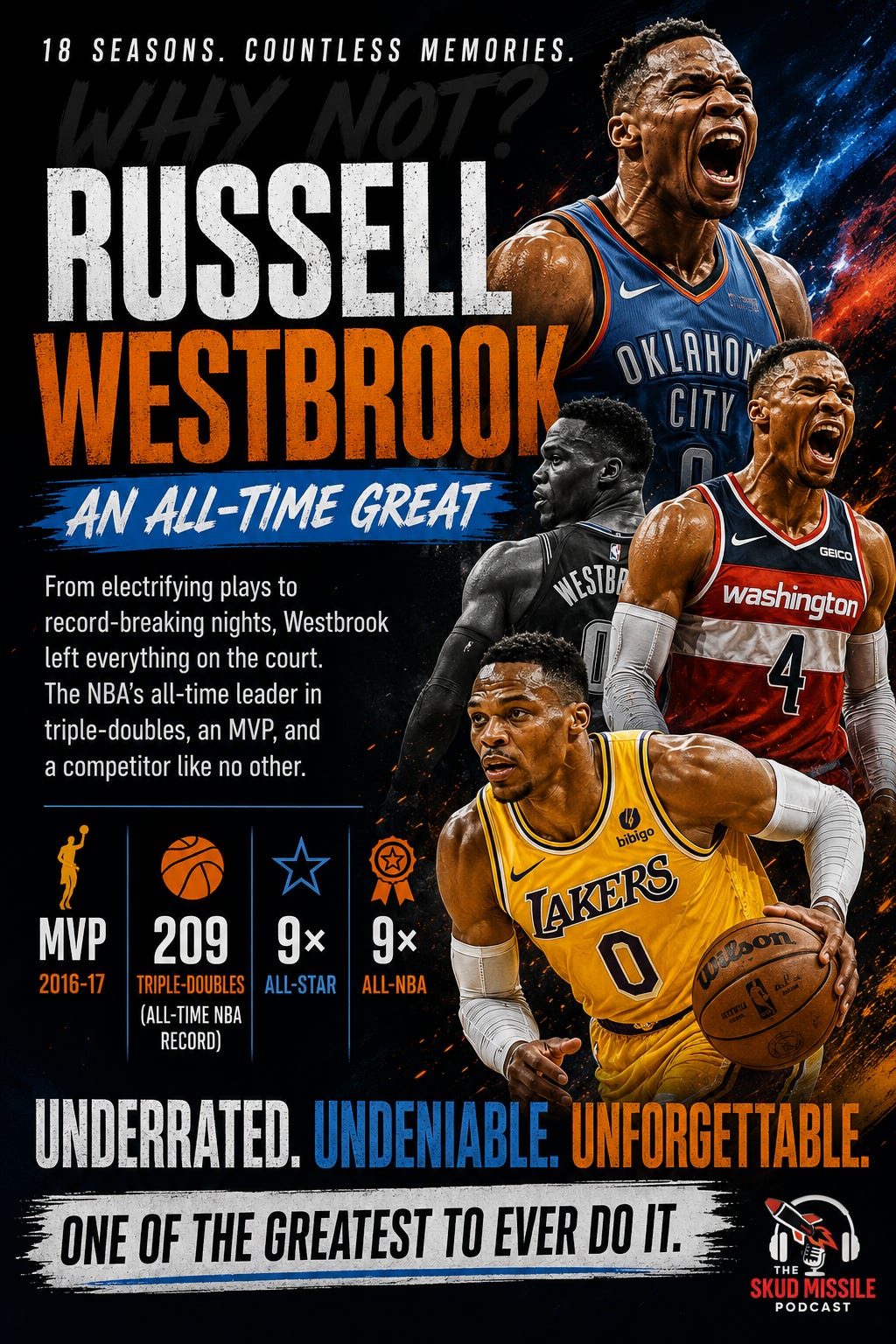
Russell Westbrook has officially retired from the NBA after 18 seasons, and maybe now we can finally appreciate just how remarkable his career was. Somewhere along the way, one of the greatest players of his generation became better known for what he did not accomplish than everything he actually did. He never won a championship. He was never an elite shooter. He turned the ball over too much, his decision making could drive you insane, and his style of basketball did not always age gracefully. Every one of those criticisms has some validity, but none of them changes what should be obvious when looking at his career as a whole: Russell Westbrook is one of the greatest basketball players who ever lived.
There was a time when averaging a triple double over an entire NBA season seemed almost mythical. Oscar Robertson accomplished it in 1961-62, averaging 30.8 points, 12.5 rebounds and 11.4 assists, and for more than half a century nobody did it again. Then Westbrook arrived. During his historic 2016-17 MVP season, Westbrook averaged 31.6 points, 10.7 rebounds and 10.4 assists. A 6-foot-3 point guard averaged nearly 11 rebounds per game while simultaneously leading the NBA in scoring and averaging more than 10 assists. It was one of the most remarkable individual seasons the league had ever witnessed, and if that had been the only time Westbrook accomplished it, we would still be talking about it today.
Except he did it again. Then he did it again. And years later, after leaving Oklahoma City, he did it again in Washington. Westbrook averaged a triple double four different times, turning something basketball fans once considered virtually impossible into something that almost felt routine. That may actually be one of the strangest consequences of his greatness. Westbrook made the extraordinary look so normal that eventually people stopped being impressed by it. Instead of marveling at what he was doing, fans began searching for ways to diminish it.
That became especially obvious with the triple double conversation. Westbrook retires with 209 regular season triple doubles, the most in NBA history. He passed Oscar Robertson’s record of 181, a number that once appeared untouchable, and continued adding to it. Yet instead of universally celebrating the accomplishment, people started calling his triple doubles stat padding. Critics argued that teammates allowed him to collect rebounds or that he was chasing assists and numbers. Were there moments when Westbrook hunted statistics? Absolutely. But the criticism eventually became ridiculous because it ignored how difficult those statistics actually are to accumulate. You still have to rebound against NBA players. You still have to create scoring opportunities. You still have to put the ball in the basket. Most importantly, you have to possess the energy, durability and ability to do those things night after night. If averaging a triple double were simply a matter of deciding that you wanted one, plenty of other players would have done it.
The résumé becomes even harder to dismiss when you step away from the narratives surrounding Westbrook and simply look at what he accomplished. He was an NBA MVP, a nine time All Star, a nine time All NBA selection, a two time scoring champion, a three time assists champion and a two time All Star Game MVP. He was selected to the NBA’s 75th Anniversary Team and finished his career with more than 27,000 points and 10,000 assists while approaching 9,000 rebounds. Add the NBA record 209 triple doubles and you are no longer discussing whether someone had a Hall of Fame career. You are discussing where that player belongs among the greatest players in the history of the sport.
Of course, the championship argument will always follow Westbrook. He never won one, and when we discuss the greatest players in NBA history, championships should matter. They are part of the equation. But they cannot be the entire equation. Charles Barkley never won a championship. Karl Malone never won one. John Stockton, Allen Iverson, Steve Nash and Patrick Ewing never won one either. Nobody seriously suggests that those players were not historically great because they never lifted the Larry O’Brien Trophy. Basketball remains a team sport, and while Westbrook played with some extraordinary talent throughout his career, including Kevin Durant, James Harden, Paul George, Bradley Beal and LeBron James, the fact that those partnerships never produced a championship should be considered part of his legacy rather than the definition of it.
It is also possible to defend Westbrook without pretending his flaws did not exist. They absolutely did. He was inefficient, finishing his career as roughly a 30 percent three point shooter. His shot selection could be maddening, turnovers were a constant issue, and there were moments when his refusal to slow down seemed to hurt his own team. As his athleticism declined, weaknesses that had always existed became increasingly difficult to overcome. His time with the Los Angeles Lakers was particularly damaging to his reputation because the fit alongside LeBron James and Anthony Davis never worked, and Westbrook became the face of everything that was wrong with that roster.
The problem is that the later chapters of his career began changing how people remembered the entire book. Prime Russell Westbrook was terrifying. There were very few players in NBA history who attacked a basketball court with the combination of speed, explosiveness and aggression that Westbrook possessed. When he grabbed a defensive rebound and started pushing the ball up the floor, you could almost feel the defense retreating. Everyone in the arena knew what was coming, including the five defenders standing between him and the basket, and sometimes none of it mattered. Westbrook attacked the rim like he was angry at it, and his violent finishes became one of the defining images of basketball during his era.
That is another part of his legacy that deserves more attention. Russell Westbrook was one of the greatest pure athletes the NBA has ever seen. We routinely mention Michael Jordan, LeBron James, Vince Carter and Dominique Wilkins when discussing basketball’s most explosive athletes, and Westbrook deserves to be included somewhere in that conversation. His first step was devastating, his acceleration was absurd, and his ability to elevate through traffic at his size produced some of the most memorable dunks ever delivered by a point guard. What made it even more impressive was that he seemed capable of playing at that speed for an entire game. There was rarely a cruise control setting with Russell Westbrook. Everything happened at full throttle.
Ironically, that relentless style was both his greatest strength and one of his biggest weaknesses. Westbrook sometimes played so fast and so aggressively that mistakes became inevitable. But I would rather remember a player for occasionally pushing too hard than for being afraid to push at all. Nobody ever questioned whether Russell Westbrook cared. Nobody ever wondered whether he was competing. He played basketball with an emotional intensity that was visible every single night, and whether you loved him or hated him, it was almost impossible to ignore him.
I think that is ultimately why Westbrook became so severely underrated. For years, basketball fans spent more time asking why he could not be someone else than appreciating who he actually was. Why couldn’t he shoot like Stephen Curry? Why couldn’t he control the tempo like Chris Paul? Why couldn’t he become more efficient? Why couldn’t he change his game? Why couldn’t he win a championship with Kevin Durant? Why couldn’t he fit alongside LeBron James? Eventually, the conversation became so focused on everything Russell Westbrook wasn’t that we stopped appreciating everything Russell Westbrook was.
And what he was deserves to be remembered. Westbrook was relentless, explosive, fearless, emotional, imperfect and spectacular. There will always be arguments about where he ranks among the greatest point guards ever because that position includes names like Magic Johnson, Stephen Curry, Oscar Robertson, Isiah Thomas, John Stockton, Chris Paul, Jason Kidd and Steve Nash. I am not suggesting Westbrook automatically belongs ahead of all of them, but he unquestionably belongs in the conversation. Where you place him is debatable. Whether he deserves to be discussed alongside them should not be.
The same applies when discussing the greatest players in NBA history regardless of position. Maybe Westbrook is not in your top 10. Maybe he is not in your top 20. That is perfectly reasonable. But there is a significant difference between debating exactly where an all time great belongs and debating whether that player was an all time great in the first place. Russell Westbrook was an all time great, and his career accomplishments make that difficult to argue against.
Sports fans have a strange habit of spending years tearing athletes apart only to become nostalgic for them once they are gone. Westbrook deserved more appreciation while we were watching him. He deserved it when he was averaging triple doubles, when he was carrying Oklahoma City after Kevin Durant left, and when he was playing basketball with a level of ferocity that few players in league history could match. We spent so much time analyzing his weaknesses that sometimes we forgot we were watching something we might never see again.
Now the career is over after 18 seasons. There is no championship, and there are plenty of flaws for his critics to point toward. But there is also an MVP trophy, nine All Star appearances, nine All NBA selections, two scoring championships, three assists championships, more than 27,000 points and more triple doubles than anyone who has ever played professional basketball at this level. There is absolutely no reason to apologize for calling Russell Westbrook one of the greatest basketball players who ever lived.
Years from now, younger basketball fans are going to look at Westbrook’s statistics and wonder how anyone could have possibly underrated a player who accomplished all of this. Those of us who watched him will know exactly how it happened. We became so accustomed to Russell Westbrook doing extraordinary things that eventually we started treating them like they were ordinary.
They never were.
And neither was Russell Westbrook.