
Kevin Durant vs. Larry Bird: Why It’s Time to Rethink the Small Forward Hierarchy
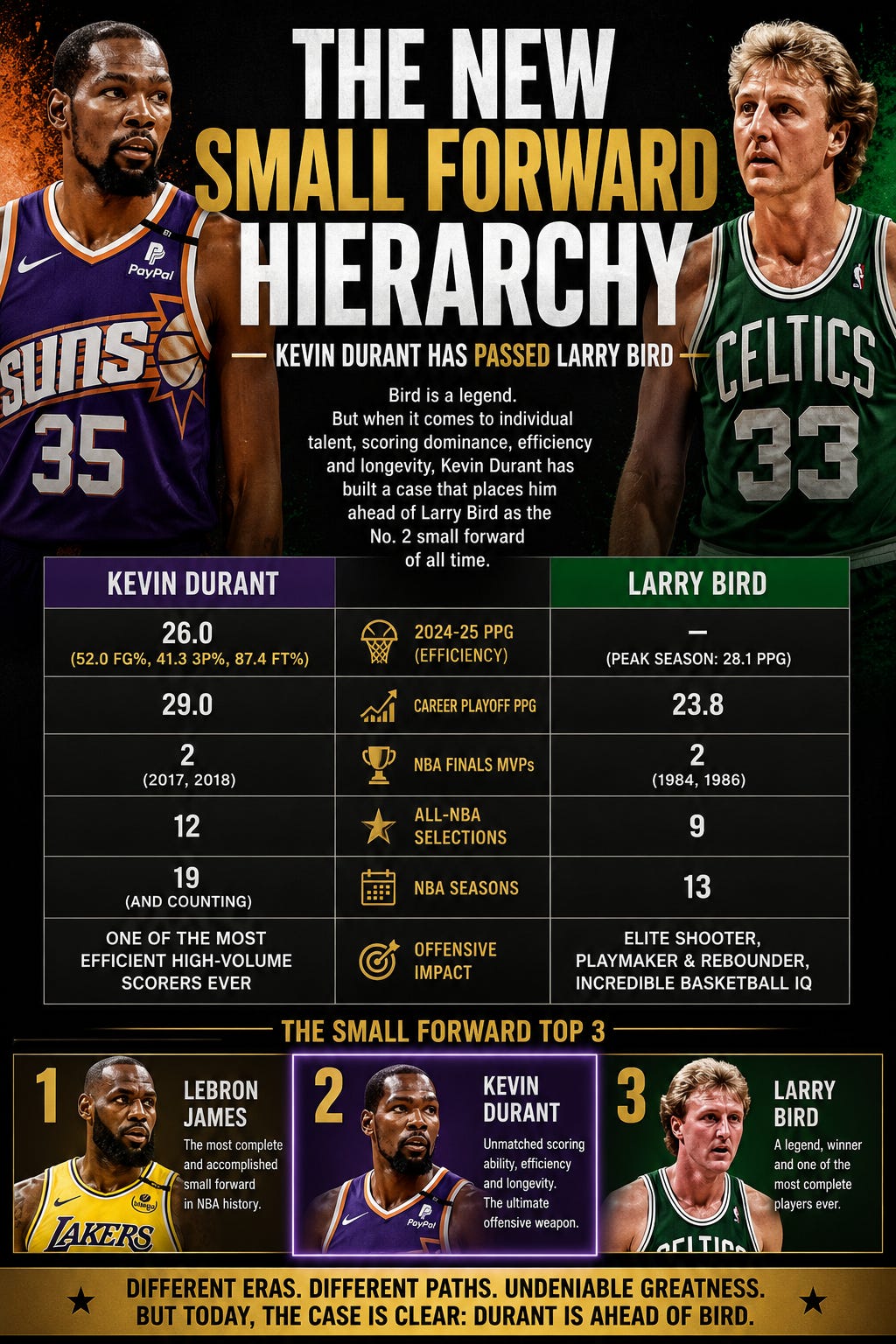
There are certain opinions in basketball that almost feel illegal to express. Michael Jordan versus LeBron James is one. Kobe Bryant’s place among the all-time greats is another. And somewhere on that list is the idea that anyone could possibly rank ahead of Larry Bird when discussing the greatest small forwards in NBA history.
I’m going to say it anyway.
Kevin Durant has passed Larry Bird.
And I think we have reached the point where the conversation about the greatest small forwards ever should begin with LeBron James at No. 1 and Kevin Durant at No. 2.
That is not disrespect toward Bird. Larry Bird is one of the greatest basketball players who has ever lived. He won three championships, three consecutive MVP awards, two Finals MVPs and helped define an entire era of basketball. His rivalry with Magic Johnson helped transform the NBA, and his combination of shooting, passing, rebounding, competitiveness and basketball intelligence was decades ahead of its time.
But acknowledging Bird’s greatness does not require pretending nobody can eventually surpass him.
Kevin Durant has.
The Most Complete Scorer We Have Ever Seen at His Size
There have been better pure shooters. There have been more physically dominant scorers. There have been players who attacked the basket with more force.
I’m not sure there has ever been another player who combined all of those scoring elements quite like Kevin Durant.
Durant is essentially seven feet tall with the offensive skill set of a shooting guard. He can bring the ball up the floor, pull up from 30 feet, operate in the midrange, score from the post, attack off the dribble and shoot over virtually any defender in basketball.
What exactly is the defensive answer?
Put a smaller player on him and Durant shoots over him. Put a bigger player on him and Durant takes him off the dribble. Crowd him and he can get to the rim. Give him space and he is one of the greatest shooters the game has ever seen.
This isn’t simply an aesthetic argument, either. Durant has been one of the most productive scorers in NBA history while maintaining remarkable efficiency. Even deep into his career, the efficiency has barely moved. In 2025-26, at age 37, Durant averaged 26.0 points while shooting 52.0 percent from the field, 41.3 percent from three and 87.4 percent from the free throw line. He earned another All-NBA selection, the 12th of his career.
Think about how ridiculous that is.
Durant entered the league in 2007, and nearly two decades later defenses still haven’t figured out how to stop him.
Because there really isn’t a way to stop him.
Bird Was More Complete. Durant Is More Unstoppable.
This is where the Bird argument deserves its respect.
Larry Bird was the better rebounder. He was the better passer. His career averages of 24.3 points, 10.0 rebounds and 6.3 assists demonstrate just how much he affected every part of the game.
If someone tells me Bird was a more complete offensive basketball player, I can have that conversation.
But if I need somebody to get me a basket against any defense, in any matchup, I am taking Kevin Durant.
That matters.
Basketball ultimately becomes a game of creating and converting difficult shots, particularly in the postseason when defenses tighten and easy opportunities disappear. Durant might be the ultimate answer to that problem.
His career postseason scoring average sits above 29 points per game. This isn’t someone who accumulated massive regular-season statistics and disappeared when the games mattered most.
Durant’s game translates.
And Yes, the Championships Count
This is where Durant’s critics usually go.
Golden State.
He joined Stephen Curry, Klay Thompson and Draymond Green after the Warriors had won 73 games. I understand why people disliked the decision. I understand why those championships are viewed differently from championships won under more difficult circumstances.
But here’s the part that sometimes gets conveniently forgotten.
Kevin Durant wasn’t riding in the backseat.
He was Finals MVP.
Twice.
Durant won Finals MVP in both 2017 and 2018. When the biggest games arrived, Durant wasn’t watching Curry carry Golden State to championships. Durant was standing at the center of them.
That has to matter.
We cannot simultaneously argue that Golden State was Steph Curry’s team and then refuse to give Durant credit for being the best player on the floor when the championship was actually being decided.
The Bird Résumé Is Incredible
There is no reason to manipulate Bird’s résumé to make the Durant argument stronger.
Bird won three straight MVP awards. He led Boston to three championships and five NBA Finals appearances. He was a 12-time All-Star and nine-time First Team All-NBA selection.
That is extraordinary.
Bird also won both regular-season MVP and Finals MVP in 1984 and 1986.
If someone ranks Bird ahead of Durant because of those accomplishments, I understand it.
But greatness cannot be measured exclusively by trophies.
Durant’s individual basketball résumé has become too overwhelming to simply dismiss because Bird has one additional championship and two additional regular-season MVP awards.
We also have to consider longevity.
Bird played 13 NBA seasons, with injuries significantly affecting the latter portion of his career. Durant has now played across parts of 19 seasons and was still an All-NBA player at 37.
Durant didn’t simply have a great peak.
He has had an absurdly long one.
Imagine Durant in Bird’s Era
Cross-era comparisons are always dangerous because basketball changes. Training changes. Rules change. Defensive schemes change. Pace changes.
But I have always found one question useful:
Would that player’s game translate to another era?
Kevin Durant’s translates anywhere.
Put Durant in the 1980s and tell me who guards him.
A nearly seven-foot forward who handles the basketball, has elite shooting range, can score from the post, can attack the basket and can shoot over defenders without needing significant separation?
He would have been a nightmare.
And before someone says the physicality of the 1980s would have overwhelmed him, remember that Durant has played nearly two decades of NBA basketball despite being relatively thin for his height. Teams have tried physicality. Teams have tried smaller defenders. Teams have tried bigger defenders. Teams have trapped him.
He keeps scoring.
Different era. Same problem.
The One Thing I Hold Against Durant
There is one part of Durant’s career that prevents his story from feeling as complete as Bird’s.
He became a basketball journeyman.
Oklahoma City.
Golden State.
Brooklyn.
Phoenix.
Houston.
For a player this great, that is unusual.
Bird is Boston.
Magic is Los Angeles.
Jordan is Chicago.
Kobe is Los Angeles.
Tim Duncan is San Antonio.
Steph Curry is Golden State.
What is Kevin Durant’s basketball home?
That’s much harder to answer.
Oklahoma City probably should have been that place. Durant began his career with the Seattle SuperSonics before the franchise relocated to Oklahoma City, and he grew into a superstar with the Thunder. He became an MVP there and took Oklahoma City to the NBA Finals.
Had he remained with that organization and eventually delivered a championship, I think the perception of his career would be dramatically different.
Instead, he went to Golden State. Then Brooklyn. Then Phoenix. Then Houston.
That movement has damaged his legacy more than anything he has done on a basketball court.
Not because changing teams makes someone less talented. It doesn’t.
But there is something powerful about a superstar becoming synonymous with a franchise and carrying that organization through different eras of his career. Bird had that. Magic had it. Duncan had it. Kobe had it. Curry has it.
Durant doesn’t.
And for me, that’s the biggest blemish on an otherwise extraordinary career.
But That Doesn’t Change the Basketball
This is where I ultimately land.
If we are ranking careers based primarily on narrative, championships and connection to one franchise, Larry Bird probably remains ahead of Kevin Durant.
If we are asking who was the greater individual basketball player?
I have Durant.
The scoring advantage is too significant. The longevity matters. The efficiency matters. The ability to dominate from virtually anywhere on the floor matters. The two Finals MVPs matter.
Most importantly, the eye test matters.
Kevin Durant is one of those rare players for whom basketball sometimes looks fundamentally unfair.
We are talking about a player with guard skills in the body of a center who became one of the greatest shooters ever while also possessing one of the deadliest midrange games the sport has seen.
There has never really been another Kevin Durant.
LeBron. Durant. Bird.
That’s my list.
LeBron James remains No. 1 among small forwards. His combination of scoring, passing, longevity, postseason success and overall control of a basketball game gives him a résumé nobody at the position has matched.
Then comes Kevin Durant.
Then Larry Bird.
I understand how uncomfortable that order will make some basketball fans. Bird occupies sacred territory in NBA history, and deservedly so. For decades, saying Bird was the greatest small forward ever wasn’t controversial. Then LeBron came along and changed the conversation.
I believe Durant has changed it again.
Larry Bird had the greater connection to a franchise. He won more championships. He collected more MVPs. He was the superior passer and rebounder.
Kevin Durant is the superior scorer, the more physically impossible matchup and one of the most efficient high-volume offensive players basketball has ever produced. He sustained that greatness for nearly two decades.
His greatest flaw isn’t anything he couldn’t do on a basketball court.
It’s that he never stayed anywhere long enough for one franchise to truly become his.
Maybe that’s why people don’t view Durant the way they view Bird. There isn’t one jersey, one arena or one franchise that completely defines him. His greatness has been scattered across the league.
But scattered greatness is still greatness.
And when Kevin Durant finally walks away from basketball, we may need to reconsider where he belongs historically.
Not somewhere behind Larry Bird simply because that’s where tradition tells us to put him.
Right behind LeBron James.
As the second-greatest small forward to ever play the game.