
Donnie Baseball: The Hall of Fame Debate That Never Seems to End
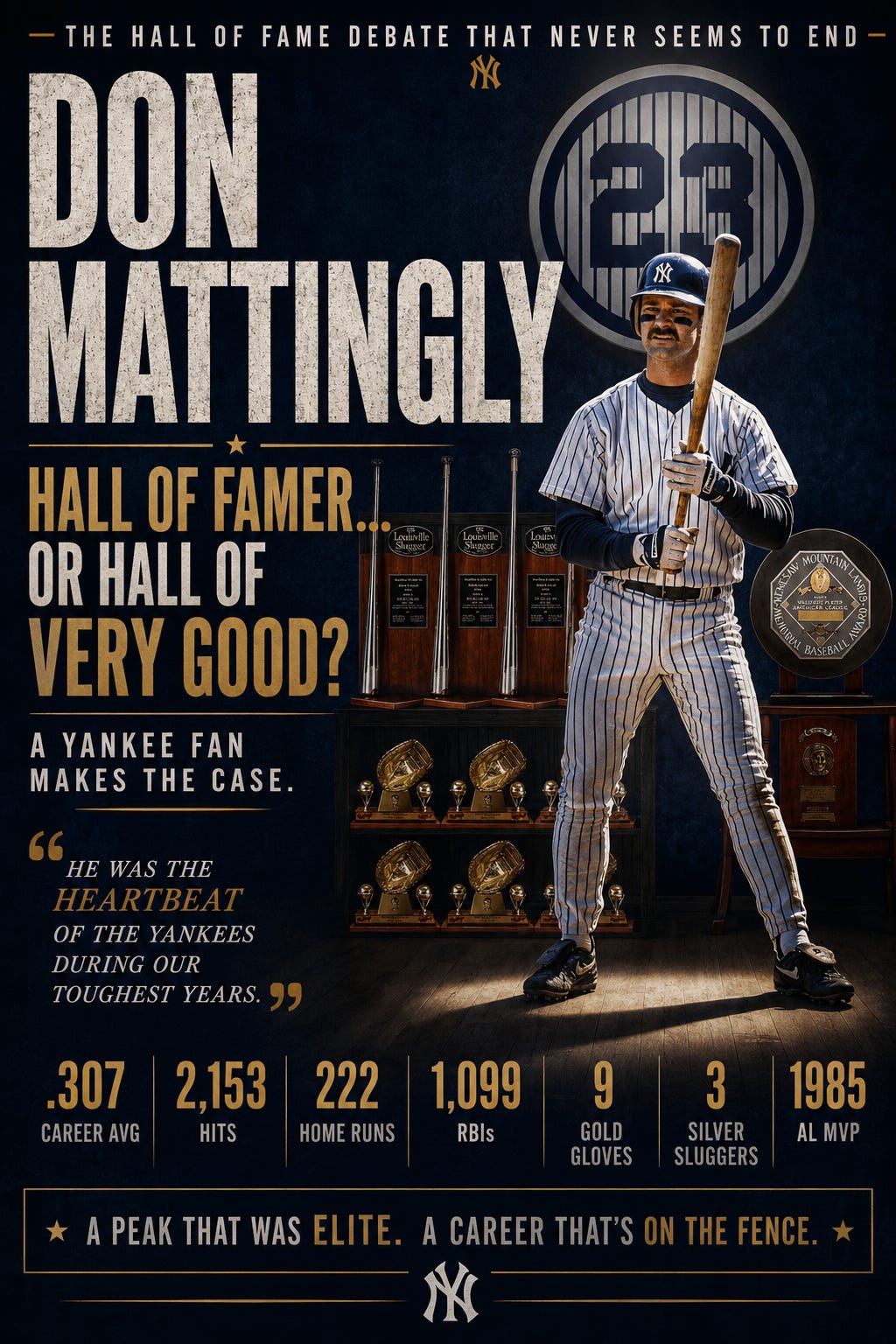
If you’re a Yankees fan of a certain generation, there’s one player whose name instantly brings back memories of a difficult era in franchise history: Don Mattingly.
Long before Derek Jeter, Mariano Rivera, or the Core Four restored the Yankees to championship glory, there was Mattingly. During a period when the Yankees were often mediocre, he gave fans a reason to tune in every night. He wasn’t just the face of the franchise—he was the franchise.
As a lifelong Yankees fan, I’ll admit right from the start that this article comes with a healthy dose of homerism. Don Mattingly was my favorite player growing up, and I’ll always believe he represented everything you’d want in a baseball player. But being honest also means acknowledging that his Hall of Fame case isn’t nearly as straightforward as many Yankees fans would argue. That’s exactly what makes his candidacy one of the most fascinating debates in baseball history.
From 1984 through 1989, there may not have been a better all-around player in baseball. During that six-year stretch, Mattingly hit .327 with 1,304 hits, 159 home runs, 684 RBIs, and 320 doubles. He won nine Gold Gloves, three Silver Sluggers, and captured the American League MVP Award in 1985. His MVP season alone was remarkable, as he hit .324 with 35 home runs, drove in 145 runs, led the league with 48 doubles, and posted a .939 OPS.
For several years, if you were starting a Major League Baseball franchise from scratch, Don Mattingly would have been one of the first names selected. He wasn’t simply an outstanding hitter—he was arguably the finest defensive first baseman of his generation. His footwork around the bag was flawless, his glove saved countless errors, and his arm allowed him to make plays few first basemen could. Those nine consecutive Gold Gloves weren’t awarded because of his reputation; they were earned through elite defensive play year after year.
Statistics, however, only tell part of his story.
Mattingly captained the Yankees during one of the most frustrating periods in franchise history. George Steinbrenner was constantly changing managers, the roster seemed to turn over every season, and playoff appearances were nowhere to be found. Despite the instability surrounding him, Mattingly remained the steady presence Yankees fans could count on. He never embarrassed the organization, played the game the right way, and became the standard for professionalism. Sometimes greatness isn’t measured solely by championships. Sometimes it’s measured by the way a player carries himself through adversity, and few players represented their franchise with more class than Don Mattingly.
Unfortunately, Hall of Fame voting isn’t based on a player’s best six seasons. It’s based on an entire career, and that’s where Mattingly’s candidacy becomes far more complicated.
A chronic back injury robbed him of what should have been the prime years of his career. After turning 29, he simply wasn’t the same offensive force. He remained an exceptional defensive player and continued to make All-Star teams, but the elite production that defined his peak gradually faded. When he retired, his career totals included a .307 batting average, 2,153 hits, 222 home runs, 1,099 RBIs, six All-Star selections, nine Gold Gloves, three Silver Sluggers, and one MVP Award.
Those are excellent accomplishments, but they don’t overwhelm Hall of Fame voters the way many first basemen’s résumés do. Modern analytics make his case even more difficult. His career WAR of 42.4 is well below the average Hall of Fame first baseman, and unlike many players already enshrined in Cooperstown, he never reached milestone numbers such as 3,000 hits or 500 home runs. Those are fair arguments against his induction.
Perhaps the cruelest chapter of Mattingly’s career came in 1995. After spending his entire career waiting for postseason baseball, the Yankees finally returned to October. Mattingly didn’t disappoint, hitting .417 with a home run and six RBIs during the Division Series against Seattle. It looked as though his long-awaited playoff opportunity had finally arrived.
Then the Yankees lost one of the most heartbreaking series in franchise history.
Mattingly retired immediately after that season. One year later, the Yankees won the first of four World Series championships in five seasons.
Baseball can be unbelievably cruel.
The player who carried the franchise through its leanest years never got the opportunity to enjoy the dynasty he helped lay the foundation for. It’s one of the saddest “what ifs” in Yankees history.
So where do I ultimately land?
If I had a Hall of Fame vote, I believe I’d vote yes.
Not because his counting statistics demand it or because advanced metrics insist upon it. I’d vote for the complete picture. His peak was unquestionably Hall of Fame caliber. For roughly six seasons, Don Mattingly wasn’t merely one of the best first basemen in baseball—he was one of the very best players in the sport.
I also believe Hall of Fame discussions should leave room for context. Injuries matter. Leadership matters. Defensive excellence matters. Being the face of the most recognizable franchise in sports during one of its darkest periods matters. Those qualities don’t always appear on Baseball Reference, but they absolutely shape a player’s legacy.
That said, I completely understand why others would vote against him.
The Hall of Fame isn’t designed to honor potential or reward careers interrupted by injuries. It’s meant to recognize complete careers, and when viewed through that lens, Mattingly’s résumé sits squarely on the borderline. His candidacy ultimately forces voters to answer a philosophical question: should the Hall reward extraordinary peaks, or should it reward sustained greatness over a longer period? There isn’t a wrong answer, and reasonable baseball fans can honestly land on either side.
As a Yankees fan, I’ll probably always see Don Mattingly through pinstriped glasses. I remember the batting stance, the mustache, the smooth glove at first base, and the way he made the game look effortless. Objectively, I understand why he still waits outside Cooperstown. Subjectively, I’ll probably always believe that Donnie Baseball embodied everything a Hall of Famer should be.
Maybe that’s why this debate has lasted for decades.
Not every Hall of Fame argument has a definitive answer. Some players leave behind something that’s harder to measure than statistics. They leave behind memories, admiration, and an impact that transcends numbers on the back of a baseball card.
For an entire generation of Yankees fans—including me—Don Mattingly isn’t remembered simply because he was a great player.
He’s remembered because, for a few unforgettable years, he felt like the best player in baseball.
And maybe that’s the strongest Hall of Fame argument of all.