
Baseball’s House Is Burning and the Dodgers Are Toasting Marshmallows
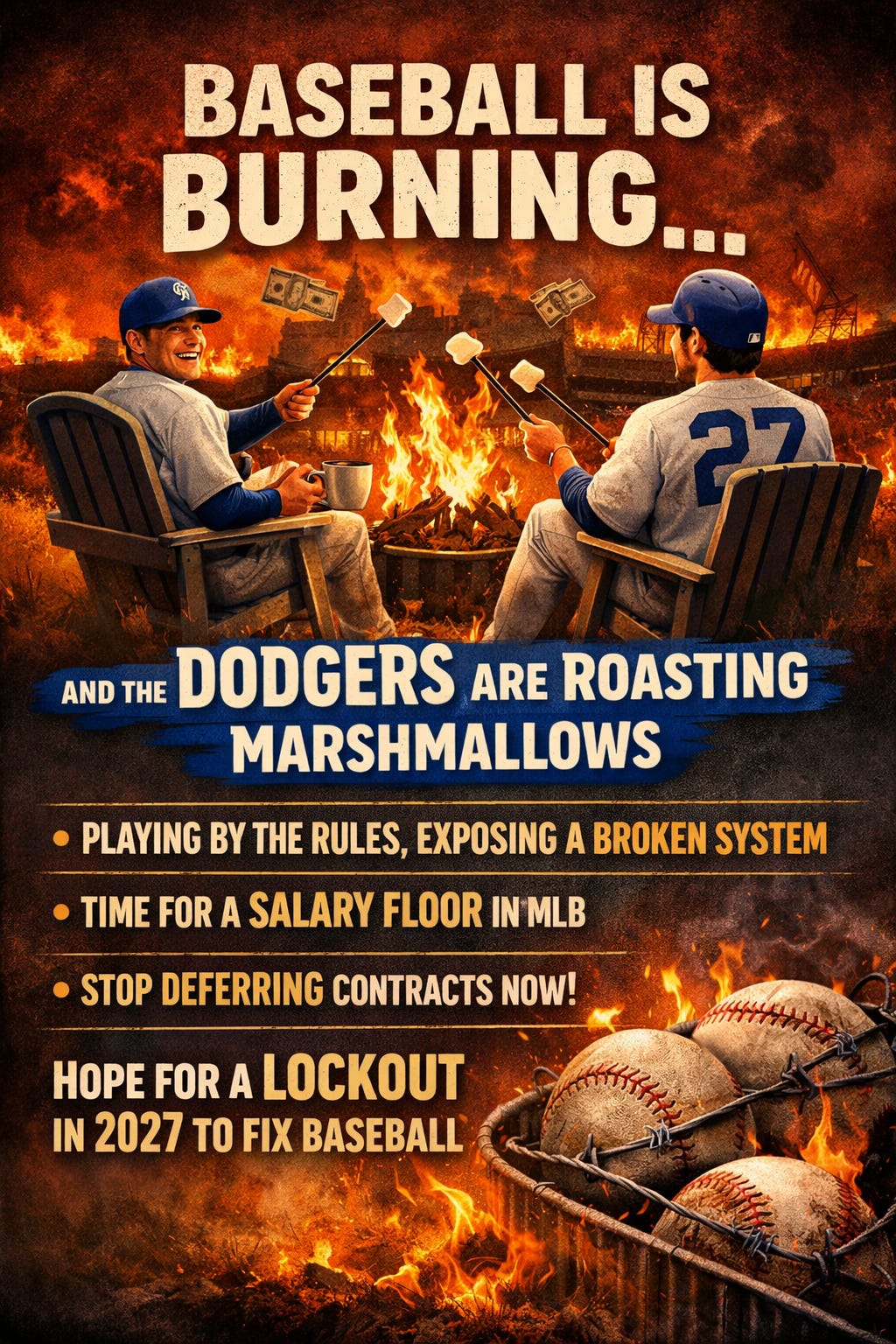
Major League Baseball is staring at a problem it no longer seems interested in fixing. Competitive balance is eroding in plain sight, and the sport’s economic divide is widening by the season. At the center of it all sit the Los Angeles Dodgers, a franchise that represents both the pinnacle of modern team building and the clearest evidence that the system itself is deeply flawed.
The Dodgers’ recent agreement with Kyle Tucker is the latest flashpoint. The deal drew outrage across the baseball world, not because Tucker is undeserving or because the contract violates any rules, but because it reinforces a growing sense that the sport is no longer operating on a level playing field. The frustration is understandable. Fans see one team repeatedly land elite talent while others are effectively priced out before negotiations even begin.
Thanks for reading! Subscribe for free to receive new posts and support my work.
The uncomfortable truth is that the Dodgers did nothing wrong. Every dollar, every clause, and every deferred payment in that contract is permitted under the current Collective Bargaining Agreement. The Dodgers are not exploiting loopholes in secret. They are openly using the tools Major League Baseball has made available to them. That distinction matters, because it shifts the blame away from a single franchise and back toward the league itself.
Los Angeles operates with advantages that few organizations can touch. Massive local media revenue, consistent attendance, global branding, and ownership willing to spend without hesitation have allowed the Dodgers to build a payroll that dwarfs much of the league. Luxury taxes exist, but for a team like this, they function more like a service fee than a deterrent. The penalties sting only if ownership allows them to.
What makes the situation more troubling is how contract deferrals have become normalized. By pushing money into the future, teams like the Dodgers can stack rosters in the present while softening the immediate financial impact. It is savvy accounting, but it also obscures reality. Payroll figures no longer reflect competitive strength in a meaningful way, and smaller market teams cannot realistically mirror these strategies even if they wanted to.
This is how baseball drifts into a two tier system. A handful of teams operate with near total financial freedom while others cycle through rebuilds, hoping their prospects peak at the right time before free agency becomes unaffordable. Fans notice. Players notice. And slowly, interest erodes in markets where contention feels temporary at best.
None of this means the Dodgers are villains. They are doing exactly what smart organizations are supposed to do. They are maximizing resources, leveraging every advantage, and pushing the rules to their limit. The real issue is that Major League Baseball has created a framework that allows this kind of imbalance to flourish without meaningful correction.
That is why the upcoming expiration of the Collective Bargaining Agreement after the 2026 season matters so much. A labor fight in 2027 may be unavoidable, and frankly, it may be necessary. Baseball does not need cosmetic tweaks. It needs structural change.
A salary floor should be non negotiable, forcing every team to invest meaningfully in its roster. Contract deferrals should be limited so payrolls reflect actual competitive intent. Revenue sharing must be reexamined to ensure it promotes winning rather than simply subsidizing ownership. Without these changes, the gap will continue to widen, and the sport will suffer for it.
Lockouts are painful. Fans lose games. Players lose paychecks. The league loses goodwill. But history shows that real reform in baseball rarely comes without conflict. If the price of restoring competitive balance is a hard reset in 2027, that may be a cost worth paying.
The Dodgers are not ruining baseball by themselves. They are holding up a mirror. What fans are reacting to is not one team’s success, but a system that rewards financial dominance over parity and predictability over competition. Until Major League Baseball confronts that reality head on, the fire will keep burning and the Dodgers will keep finding new ways to thrive within the rules they were given
.
Thanks for reading! Subscribe for free to receive new posts and support my work.